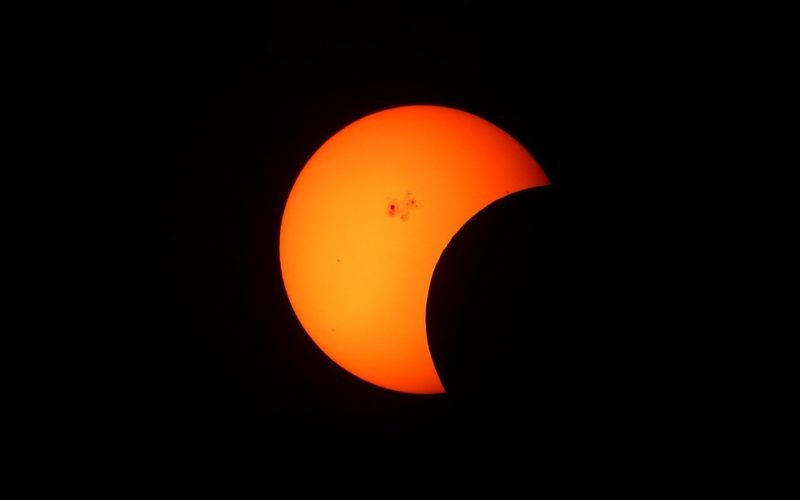
Few natural events have gripped the human imagination quite like a solar eclipse. For a brief, breathtaking moment, the moon slides between the Earth and the sun, plunging the world into an eerie twilight. Today, millions of people travel thousands of miles just to witness totality. Yet for most of human history, this same spectacle was a source of dread — a cosmic warning sign that something terrible was about to unfold.
Fear written in the sky
Across ancient cultures, solar eclipses were almost universally interpreted as bad omens. The sudden disappearance of the sun — the giver of life and warmth — made little rational sense to early civilisations, and that uncertainty bred fear. In ancient China, people believed a great celestial dragon was devouring the sun, prompting crowds to bang drums and shoot arrows into the sky to scare the beast away. In Norse mythology, two sky wolves named Sköll and Hati were said to chase the sun and moon across the heavens, and an eclipse meant one had finally caught its prey.
The ancient Greeks, despite their considerable scientific achievements, were not immune to eclipse anxiety either. The historian Herodotus recorded that a solar eclipse in 585 BC abruptly halted a battle between the Medes and the Lydians, who interpreted the darkening sky as a divine call to end their conflict. Fear, it turns out, can be a surprisingly effective peacemaker.
When science changed everything
The shift from fear to fascination began slowly, as astronomers developed the tools and knowledge to predict eclipses with remarkable accuracy. The ancient Babylonians were among the first to recognise patterns in eclipse cycles, using a roughly 18-year period known as the Saros cycle to anticipate future events. This knowledge was power — not to share with the public, but to leverage for political and religious authority.
It was not until the Scientific Revolution of the 16th and 17th centuries that eclipse observation became a serious tool for discovery. Astronomers began to use eclipses to study the sun's corona, measure the speed of light, and test the predictions of new physical theories. Most famously, the 1919 total solar eclipse provided the first experimental confirmation of Einstein's general theory of relativity, when observations showed that starlight bent around the sun exactly as Einstein had predicted.
Eclipse tourism and the modern sense of wonder
Today, the response to a solar eclipse could not be more different from those ancient scenes of panic. Eclipse chasers — dedicated travellers who plan trips years in advance to stand in the path of totality — represent one of the most passionate communities in amateur astronomy. The 2024 total solar eclipse, which swept across North America in April, drew tens of millions of spectators and generated enormous economic activity across the regions it crossed.
What draws people now is precisely what once terrified them: the overwhelming, disorienting sense that the natural world operates on a scale far beyond everyday human experience. Standing in the moon's shadow, watching the sun's corona blaze against a darkened sky, many eclipse watchers describe feelings of profound awe — even tears. Scientists who study the psychology of awe suggest that such experiences can foster humility, social connection, and a deeper sense of meaning.
The same sky, a different story
The eclipse itself has not changed. The geometry of the Earth, moon, and sun remains as it was when ancient priests scanned the heavens in dread. What has changed is the story we tell about it. Armed with scientific understanding, we have transformed a source of terror into one of the most sought-after natural experiences on the planet. That shift speaks volumes about the power of knowledge — not to diminish wonder, but to deepen it. The sky still has the ability to stop us in our tracks; we have simply learnt to look up with curiosity rather than fear.